AI and jobs: who will help people move forward?
I believe major AI developers should already be allocating a substantial share of revenue and profit to support people whose work is changed by automation. Responsibility for the transition should grow alongside the technology’s capabilities.
The cost of transition belongs in the budget
When a company automates work, its calculation usually includes development, equipment, subscriptions and expected savings. It should include another essential cost: support for people whose responsibilities shrink or disappear. Otherwise, the business benefits while the individual pays for the transition through lost income, time and confidence in the future.
My position is straightforward: this support should be planned before redundancies. People have families, housing costs and existing commitments. They cannot put life on hold while finding a new occupation. The greater the change in the labour market, the more important it becomes to establish a workable route to the next job.
The scale of change calls for precision
The ILO and NASK’s 2025 study finds that roughly one in four workers worldwide is in an occupation with some potential exposure to generative AI. This assesses the scope for tasks to change; it is not a count of future redundancies. The authors see job transformation as more likely than complete replacement.
Yet changes to even part of a role can mean a loss of earnings or access to an entry-level job for an individual. The absence of a precise forecast of mass redundancies therefore does not remove the need to prepare. Support should reach people who actually experience the consequences, with decisions based on their circumstances rather than dramatic predictions.
ILO / NASK — Generative AI and Jobs (2025) ↗Responsibility should be shared
This includes OpenAI, the developer of ChatGPT; Anthropic, the creator of Claude; Moonshot AI, the creator of Kimi; DeepSeek; Google; and Meta. Companies that build AI and earn money from its adoption should help finance the transition.
Employers also have a role: they receive the savings from automation and make staffing decisions. Public institutions, education providers and professional communities can contribute infrastructure and routes to employment. Responsibility should not be left with a single party. A shared mechanism needs to make each participant’s contribution clear.
Support must be tangible
I see this as support throughout a person’s transition. Access to a course alone is insufficient. People need a clear plan, income while learning and an opportunity to use their new skills in real work.
The programme should have four connected parts:
- Income support: predictable payments for an agreed period, allowing people to learn and seek work without immediately losing the means to support themselves.
- Personal guidance: a specialist who helps assess experience, choose a direction and build a realistic plan.
- Training for an actual job: funded learning, practical experience, a mentor and the necessary tools.
- A route to employment: placement support, a paid internship, a move within the company or help starting a business when that is the person’s informed choice.
How the transition could be funded
We need ongoing support funds with contributions agreed in advance. For major AI providers, this should represent a substantial share of revenue and profit; for businesses adopting AI, it should be part of the demonstrated economic benefit of automation. Contributions should reflect participants’ financial capacity and the actual need for support.
A universal percentage without calculation would be a slogan. A workable budget starts with the number of people, the cost of support, the length of transition and a reserve for those whose search takes longer. Participants can then agree on a contribution formula and review whether funding is sufficient. Commitments should be established in advance so that assistance does not depend on the next publicity campaign.
People’s experience should be preserved
An employee who has worked with customers for years understands their questions, conflicts and expectations. A document specialist knows where errors occur. That experience can be useful in reviewing AI output, improving service, handling difficult cases and helping a team learn.
But renaming a role does not create a new job. It needs genuine responsibilities, suitable training, a position to fill and decent pay. Not everyone wants or is able to become a programmer. The programme should offer several viable paths and account for age, health, family circumstances and available vacancies.
The outcome should be sustainable employment
Support should have clear eligibility criteria and a way to appeal a refusal. Decisions about a person should not be left entirely to automated scoring. Worker representatives should participate in the programme’s governance, with independent scrutiny of expenditure and results.
What matters is a return to stable income, rather than the number of certificates issued: how many people find work, retain it several months later and receive acceptable conditions. Their personal data should remain protected. If training does not lead to work, the programme needs to change.
Preparation should begin now
Businesses can start with an honest review of which tasks will change, who performs them and how freed time could be used. Where possible, developing employees and moving them into new responsibilities should come first. If redundancies are unavoidable, the support plan should already be in place.
A lack of preparation risks distrust, inequality and social tension. Supporting people should be part of the way AI develops. I support automation and see its potential. For me, professional responsibility also means helping people find their place in the world we are creating.
What to take away
Companies benefiting from AI should invest in people before displacement occurs. A successful transition means more effective businesses and a decent future for individuals.
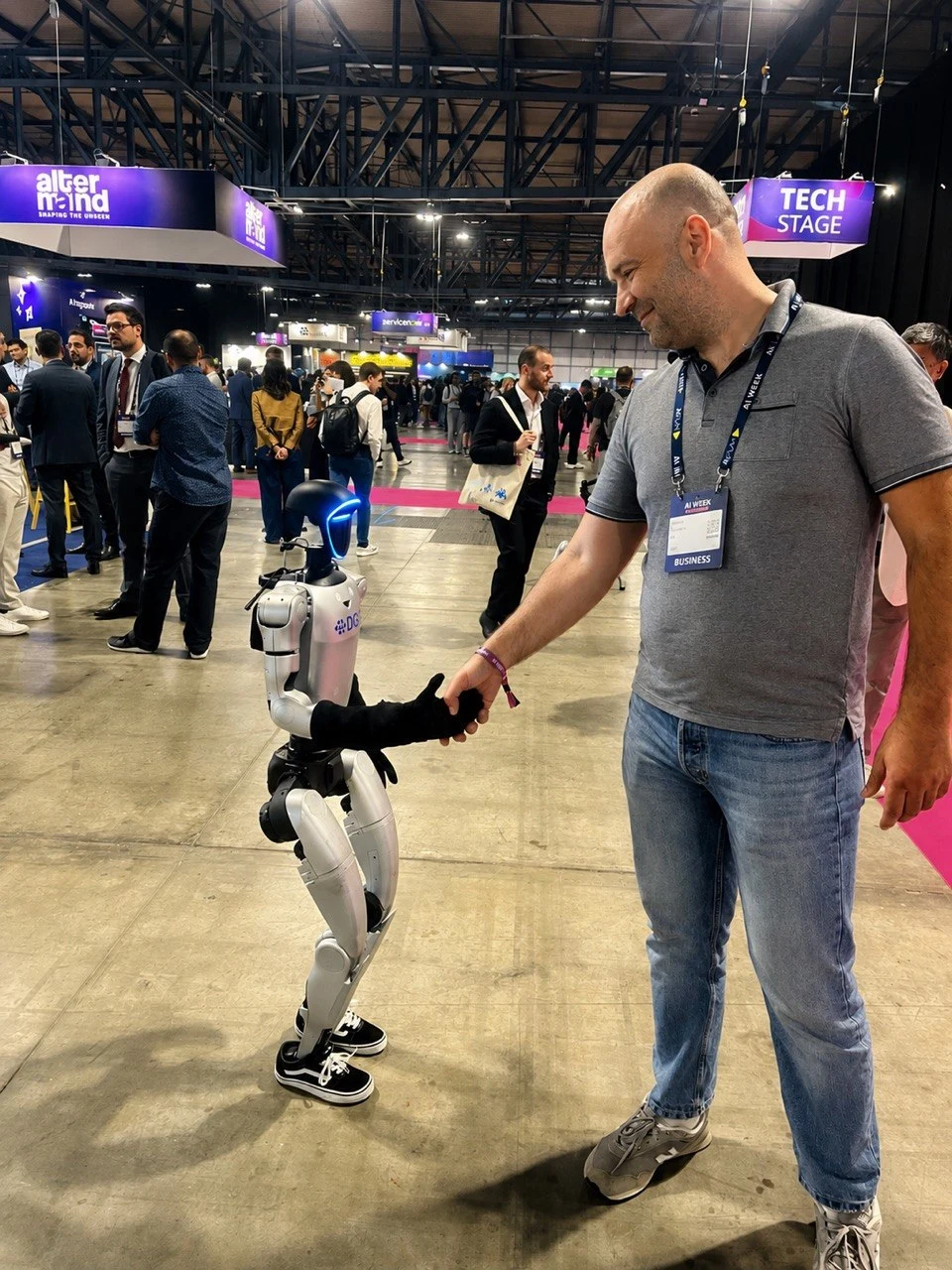
A robot at AI WEEK
A short demonstration at the conference. A robot moves and dances in front of visitors.
AI WEEK website ↗